
Token economies are often comprised of a complex set of various policies and financial features. As the blockchain and web3 space have grown in their adoption and product types, the complexities of these systems have increased. With respect to the discussion of multi-token economies, perhaps the single biggest shift has been in GameFi, where popular titles like Axie Infinity have made these systems popular, though multi-token ecosystems exist outside of this subsegment as well.
In a single token economy, the various aspects of a token economy are entirely encapsulated into a single token ecosystem. Everything from governance, value accrual, fungibility, and utility are packaged under a single token symbol. Multi-token ecosystems, by contrast, parse out and break up the characteristics of a particular token economy into two or more tokens. The rationale for this may vary, but our research suggests that there are several reasons why projects have adopted multi-token economies:
- Platform is primarily reward or incentive-based
- An inflationary token is required
- Fixed vs. mintable supply differential requirements
- The desire to isolate the negative effects of a token economy to a particular token
- A misconception that two or more tokens will have a greater additive effect on the overall token economy
- A desire for additional complexity for the sake of optics
- The desire to parse out utility features and security-related features to separate token ecosystems
However, multi-token ecosystems should be implemented with caution, as their negative attributes from an overall economic standpoint may outweigh any perceived benefits gained from their implementation.
Value Accrual is Split
Perhaps one of the single most significant issues with a multi-token ecosystem is that any potential value accrual must be split across two or more tokens. This means that rather than having a single token with the totality of the ecosystem value (as measured in market capitalization) accrued to that one token, a multi-token ecosystem must contend with the dilution of the value across two or more tokens, essentially preventing a single large market cap metric from forming, at the expense of apportioning this to multiple tokens.
To better explain this, we cite an example of a once-popular two-token ecosystem implemented by Star Atlas. The current total ecosystem value of Star Atlas is approximately $76.3M. However, a casual lookup by a new potential purchaser might result in pulling up the metrics for ATLAS, which would display just 39% of the total ecosystem value and provide a rather incomplete picture of the ecosystem value. A buyer may dismiss the investment of an otherwise promising project simply because of an incomplete picture.
| Token Symbol | Type | Market Cap | Performance from ATH | Volume (24h) | Circulation (Percentage of Max) | Max Supply |
|---|---|---|---|---|---|---|
| ATLAS | Reward, Currency | $29,980,283 | -98.9% | $717,560 | 9.80B (27%) | 36B |
| POLIS | Governance | $46,380,913 | -98.4% | $327,133 | 153.0M (43%) | 360M |
| Totals | Totals | $76,361,196 | - | $1,044,693 | - | - |
As of 12-Mar-2023; Source: CoinMarketCap
Which Token?
Perhaps a more informed buyer performs a more thorough analysis and finds two or more tokens in their search. Which token should they buy? This is not immediately clear, even in well-developed projects. Using Star Atlas as an example, ATLAS might seem like the right token to buy, since it has the project’s name embedded in the token symbol.
However, POLIS is actually the governance token meant to be held by investors and is intended to be a “long-term store-of-value” in their own words. ATLAS by contrast is merely a currency used for rewards and transactions and by their own words, designed as an "inflationary" token. Thus, multi-token ecosystems prove challenging to analyze by speculators and at best, require careful consideration in one’s purchasing decision, and at worst, sow confusion and may potentially result in the loss of a new token buyer.
Isolating Token Attributes
Designers of token economies may be tempted to isolate certain ecosystem attributes to one of the tokens in a multi-token ecosystem. For example, Axie Infinity’s token economists designed a two-token ecosystem with one token (SLP) designed as a secondary token responsible for earnings payouts in their play-to-earn economy. The primary token (AXS), meanwhile, is a governance token, responsible for making financial decisions related to the DAO treasury, where platform profits accrue. The rationale behind creating a secondary token was to prevent any price volatility attributed to the natural selling pressure that SLP was likely to experience (from players cashing out their earnings and converting them to other currencies such as fiat) from affecting their overall token ecosystem. In this way, it was thought, that the price of the “main token,” AXS, could be preserved while SLP could be issued as needed to fund player earnings.
At the outset, this system appeared to work as designed. In fact, the unabated minting of new SLP temporarily caused its market cap to actually exceed its parent token AXS, reaching $17.2 billion. For a period of time, traders were purchasing SLP instead of AXS, as evidenced by its daily volume surpassing that of AXS.
The main issue with this approach is that economic systems are highly complex and intertwined. Furthermore, well-developed markets with highly-liquid tokens are efficient. What this means is that it is impossible to isolate the characteristics of an economy to a secondary token without expecting these effects to impact the overall ecosystem value and consequently other tokens in a multi-token ecosystem. In the case of Axie’s SLP, as new players were onboarded en masse by a fast-growing collection of gaming guilds, the payouts in SLP had to scale equally. As with any ecosystem, economic value cannot be simply created out of thin air, and the massive printing of new SLP tokens resulted in a phenomenon known as hyperinflation. This was partially offset by the substantial surge in breeding, which requires SLP to initiate. However, as growth leveled, the need for new Axie (their in-game NFTs required for gameplay) declined, essentially drying up the demand for SLP. When combined with the consistent selling pressure of SLP by players earning it to replace their living wage, the price declined rapidly, necessitating larger SLP minting and payouts to sustain earnings. As new tokens were printed, the existing supply was devalued, creating a self-fulfilling race to zero.
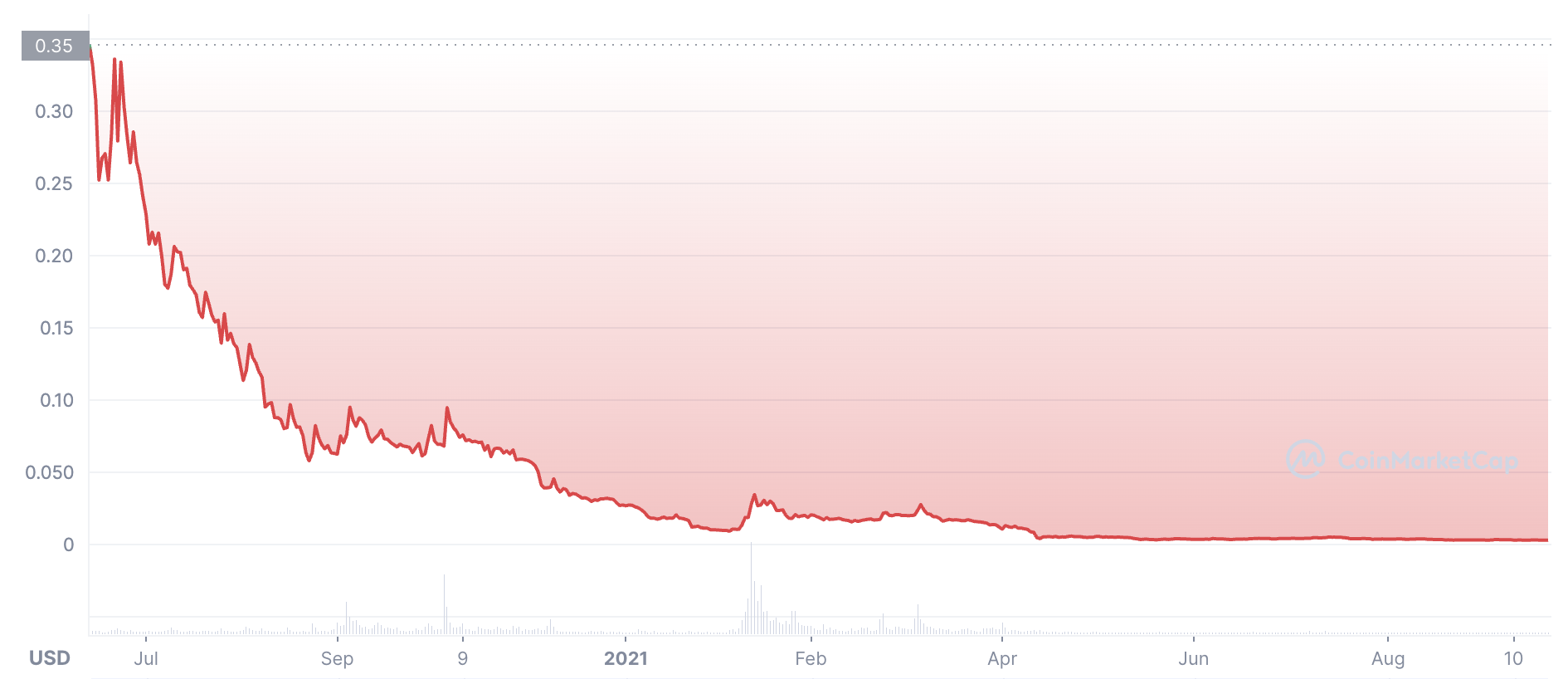
Axie Infinity’s SLP price decline from its peak tells a story of how hyperinflationary token economic policies can be detrimental to an ecosystem
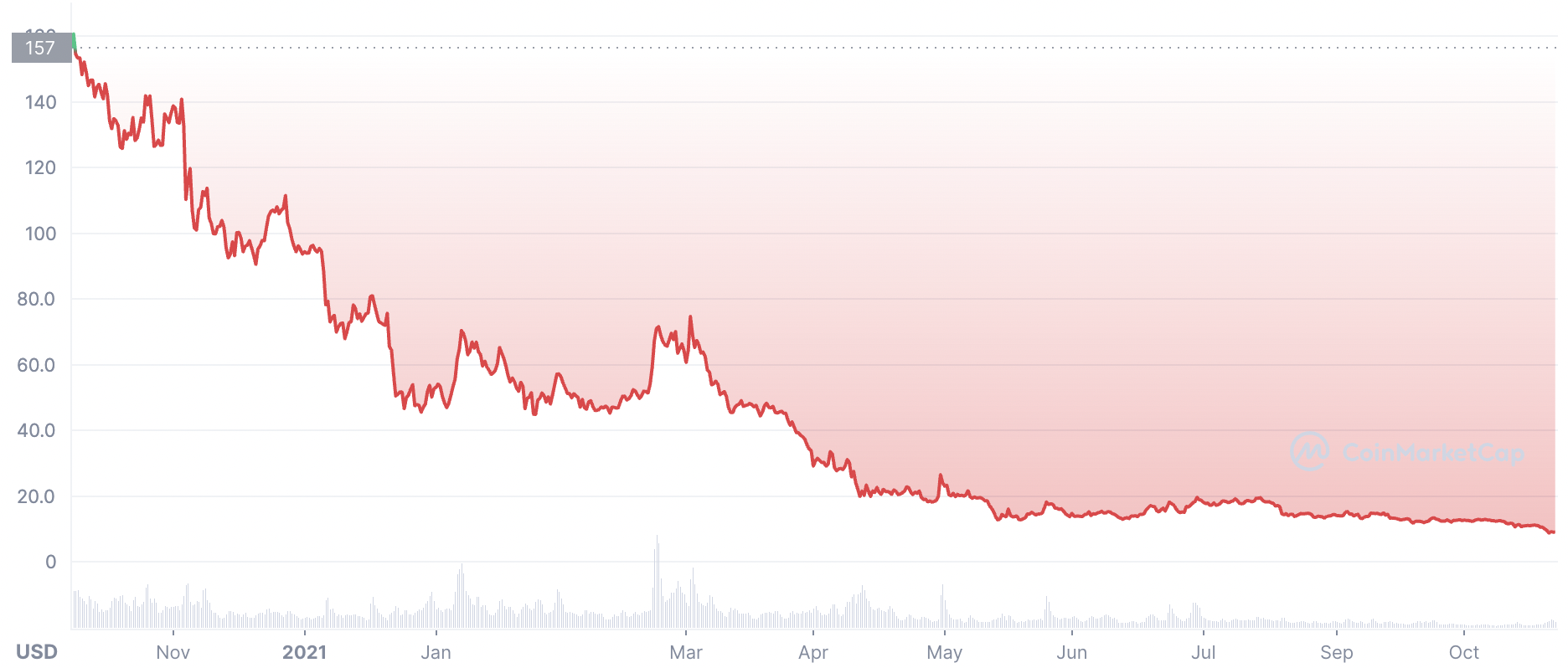
Trickle-on effects just months after SLP's decline affect Axie Infinity’s parent token, AXS, demonstrating the impossibility of confining the negative effects of a token policy to a secondary token.
In an ecosystem designed around paying its users, a rapidly declining currency results in fewer players being onboarded, and existing players slowing or entirely suspending their activity on the platform. This ultimately reduces the velocity on the parent token, AXS, as no economic activity on the platform (such as minting and breeding Axies) is performed. Natural selling pressure from speculators against the main token isn’t counteracted, and in fact, is exacerbated by increased selling from players, as they seek to make up for losses incurred by the price decline of the secondary token, SLP. Unfortunately, this has led to a substantial decline in the total ecosystem value of Axie Infinity and demonstrates why a secondary token does not necessarily shelter the economic effects from the primary token.
Advantages of Single Token Ecosystems
Single token ecosystems are not immune to the effects of dominant market forces and must be combined with a sustainable token economic model to be viable. Still, their use is compelling when compared to multi-token ecosystems as they tend to be simpler to implement and maintain, sow less confusion amongst new potential buyers, and allow value accrual to occur in totality with just the one issued token. As in the case of Axie Infinity, which would otherwise be a $1B+ token at its current market value (if it was implemented as a single token), because its ecosystem value is split, neither token has a market cap that exceeds the unicorn billion dollar mark. However, the markets are likely fairly efficient with this project – new projects may experience a substantially greater dilution in value across multiple tokens.
| Token Symbol | Type | Market Cap | Performance from ATH | Volume (24h) | Circulation (Percentage of Max) | Max Supply |
|---|---|---|---|---|---|---|
| SLP | Earnings token | $115,537,500 | -99.3% | $6,282,751 | 42.6B (100%) | Infinite |
| AXS | Governance | $913,664,211 | -95.2% | $20,917,311 | 115.6M (42.8%) | 270M |
| Totals | Totals | $1,029,201,711 | - | $27,200,062 | - | - |
As of 12-Mar-2023; Source: Cryptorank.io
Addressing Concerns with Volatility
Some opponents of single-token ecosystems may cite the added volatility of speculation that may otherwise be mitigated by implementing a second, more "stable" token into the ecosystem. Stability may be desired by projects that intend to use a token as a spendable currency on the platform. However, tokens do not achieve stability on their own, some outside force is required to maintain stability, such as a peg to a benchmark or target price. In practice, this is expensive and complicated to implement, requiring mechanisms similar to those implemented by stablecoins to maintain. Should that be the case, a project could simply supplant this second "stable" token with USDC, which would negate the requirement to build complex and expensive stability mechanisms or the requirement to store a reserve currency for the peg. USDC would arguably be far more liquid, and more widespread in its use. Users could simply trade between a single token and a stablecoin to achieve the same desired effects. Furthermore, a project-issued, non-pegged stable token does not provide much value to the end user. It does not accrue value by design and subjects the holder to risks of loss due to an inability to maintain a peg (we cite Terra’s LUNA decline as an example) in a volatile market.
When Used as Staking Tokens
In some projects, a secondary token is used to specifically represent a staked token derivative sometimes called a sToken. sTokens are tradable and fungible crypto tokens that are offered by projects to those who stake the project's primary token. A sToken has the unique benefit of providing its holder with a liquid token while their primary token is staked and locked in a smart contract. sTokens typically use the primary token symbol after a lowercase “s” to denote the staked derivative.
sTokens are commonly issued in the following ways:
Liquid Staking Token – in this approach, one staked primary token may directly generate or spawn a fixed ratio of liquid sTokens. Typically, no additional tokens are claimable without additional staking commitments, and sometimes the originally staked tokens are not redeemable after they are staked, resulting in a one-way staking transaction similar to what we currently see with Lido Finance’s stETH. In liquid tokens, rewards can still be made to accrue to the overall value of the token, rather than emitting additional sTokens. In other cases, the sToken can be returned to redeem the originally staked primary token.
Reward Derivative – in this approach, staking rewards are produced and generated exclusively in the sToken. Rather than claiming additional tokens of the primary token type, the reward is produced in this derivative token. This means that the original token is not being affected by the inflation of the sToken reward claims.
When issued as staking rewards against an annual percentage rate, sTokens act like any other secondary token in a two-token ecosystem. That is, they are dilutive to the entire value of the ecosystem. To make staking rewards worthwhile to stakers, projects must come up with meaningful utility for these sToken derivatives, to incentivize users to earn them, and to create a secondary market value for the tokens so that they are truly fungible. An example might be enabling these sTokens to be redeemed for services or features on the platform, or with partners. However, anything that can be created to make sToken have value and utility, could be used to create the same value and utility for the primary parent token. Thus, projects need to bisect features between the two, pulling some utility from the primary token in order to create secondary market value and appeal to the derivative sToken. Thus, sTokens must be dilutive to the primary token to create meaningful incentives to drive staking activity. If sTokens are perceived to be of low value due to poor utility, lack of feature access, or of actual low value due to a soft secondary market, then the participation in the staking of the primary token will be diminished, reducing the effectiveness of staking programs. Thus, projects should be acutely aware of how secondary sTokens might impact their overall token economy.
sTokens that can be redeemed for their primary token are inflationary to the token ecosystem. As new sTokens are minted and rewarded for staking, their conversion back to the parent token effectively transfers this secondary token inflation back to the parent token as well. New parent tokens may need to be minted to enable this unless a project carefully calculates the economics of the sToken emission and redemption value to be in balance with the originally staked supply.
Regulatory Concerns
There may be a case where a two-token ecosystem may make sense. In well-designed token economies, an external value accrual mechanism may be implemented, which is likely to classify such a token as a security. Tokens sold in an initial offering to fundraise and provide capital for the development of the platform may also be considered a security. Thus, a secondary token with pure utility function might be desirable to allow its usage without the complexity of navigating through a particular jurisdiction's regulations. This does not eliminate the requirement for special handling of security tokens, altogether, but may help better parse out security-specific attributes to one token vs another.