
One of the most exciting concepts introduced into the crypto space is that of the earning economy. Earning-based economies allow their participants to earn tokens in exchange for performing a certain action such as playing a game (“GameFi”) or exercising (“FitFi”). The concept of earning tokens in blockchain-based applications is nothing new and has been around since at least 2018. However, the 2021 bull market led to a rush of new liquidity in the space, spawning a new era of earning economies. Perhaps the most well-known of these is Axie Infinity, whose popularity made it the largest play-to-earn economy in the blockchain space, a feat that has not been topped since. For a short period of time, its popularity allowed it to provide a livable wage to gamers in countries like the Philippines.
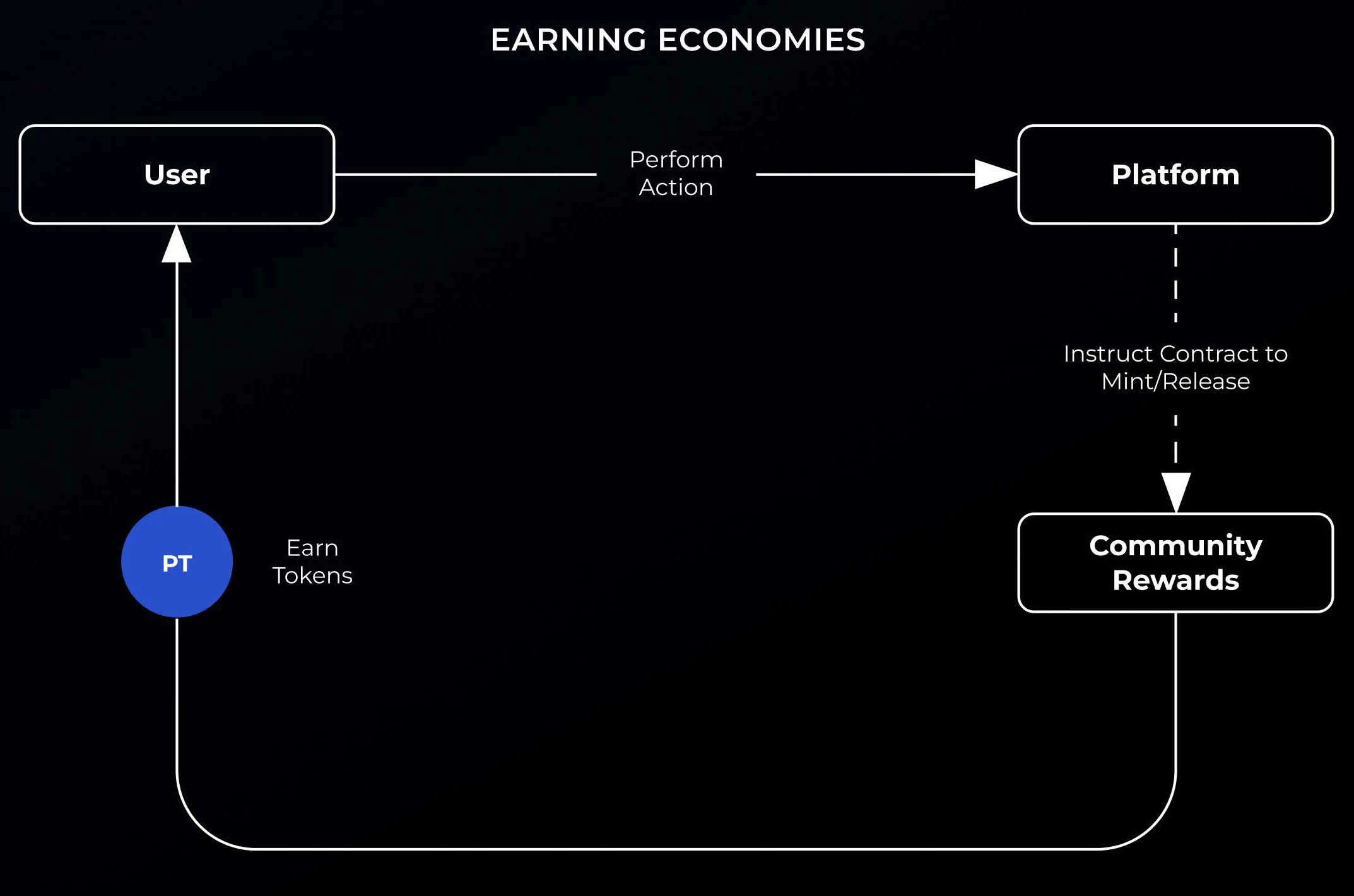
Dependency Effects of a Reward Payout
In earning economies, many individuals participate in the platform for the sole purpose of earning a living wage. Thus, they must eventually sell their earned tokens to convert them to usable and fungible value in the real world. The issue that some of these platforms have faced is that sell pressure is rarely evenly distributed along a time curve. Instead, many users hoard tokens as strong initial demand results in sometimes significant price increases. The temptation to time the market and sell at the top is oftentimes too great, leading to an accumulation of future sell pressure. Typically, some external force triggers a sell-off, which concentrates the supply inflation into a very short interval of time. As these previously hodled tokens now enter the secondary market, an oversupply shock drives the price of a token down by making each existing one, incrementally less scarce. As the price declines, token holders rush to convert their quickly dwindling earnings to other tokens, essentially competing in a race to zero.
Demand Isn’t Infinitely Scalable
Whereas in a mintable token supply, the supply may potentially be infinite, the demand for the token cannot. Even in the most popular ecosystems, demand growth must slow and eventually stop altogether. This is because demand is driven by individuals and their ability to spend on the platform, both of which are finite. In the still-nascent crypto markets, where awareness and market share are limited, this is likely to occur sooner than later.
Furthermore, as prices decline, reward payouts eventually decouple from a fixed daily standard. This results in a stall in user growth, reducing the demand for tokens, and exacerbating the price decline. This inevitably increases sales as token holders race to capture whatever value is left. Eventually, the earning economy becomes unsustainable as the value of daily earnings falls below what an individual can live off of, invalidating the business model. Some users may be caught holding a bag of tokens, watching their value drop precipitously.
In short, you cannot create value from nothing. Without an external value injection system, this race to zero is unavoidable.
Effects of a Fixed Supply
While much of the discussion around earning economies has been focused on the effects related to an infinitely mintable supply, the effects of a fixed supply token will initially mirror a mintable token, at least in the short term.
All things equal, if a fixed token supply mints at a rate equal to a protocol using a mintable token, the rate of inflation and its deleterious effects will be the same. However, a reward pool, no matter how large, will eventually run out in a fixed supply economy, since by definition, the amount of tokens allocatable to rewards is finite. Thus, long-term and sustained inflation is unable to occur because no new tokens can be introduced into the supply from reward payouts alone. While this may solve the effects of long-term unabated inflation, it presents yet another problem – the inability to sustain a game’s economics due to exhaustion of the payout mechanism. Thus, a carefully crafted economic model is required when utilizing a fixed token supply for these types of earning economies.
Initial Performance May Mask Economic Flaw
Perhaps one of the biggest issues with such economies is that their short-term performance may mask underlying issues, especially upon initial release into the market where demand is highest. This can mislead token holders, investors, and the team itself into thinking that their ecosystem is sustainable and that they've correctly designed a proper earning economy. A token experiencing high market demand with low liquidity may result in noticeable price increases, leading token earners into believing that their earnings represent a livable wage, or are sustainable. However, tokens must eventually be sold to other cryptocurrencies to realize these earnings, revealing any underlying issues.
Input of Economic Productivity
Earning economies are not consigned to ultimate failure if they understand how to build strong and sustainable token economies. Token ecosystems must have a consistent source of economic input in order for token value to accrue.
Like any viable business model, they must generate revenue and earn money by selling something of value. In web2 games, users purchase a license to download a game. Some games sell so many copies they earn billions of USD in revenue from this. Indeed, if these same games were to change their model to give away free money just for participation, their ability to stay in business would be cut short.