
Staking is the act of depositing or locking tokens into a wallet or smart contract in exchange for a reward or other benefit. The concept of staking was first introduced by two researchers in 2012 and became a reality with the launch of their project, Peercoin. Peercoin was the first hybrid proof-of-stake currency and required validators to commit a certain balance of the project’s tokens, called a stake, to secure the network. Over the years, the concept of locking tokens in exchange for rewards has evolved. Today, there are several reasons why a project or protocol may implement staking.
Reducing Circulating Supply – tokens that are staked, while technically considered part of the circulating supply, temporarily pause the activity of those tokens for as long as they are held in the staking contract. For example, as of the time of this writing, approximately 92 million APE are held in staking contracts out of the total of 368 million, meaning 25% of the total circulating supply is held in staking contracts and thus not being purchased or sold. The effect is that these tokens are not available on the secondary market and therefore are not contributing to sell pressure while making the remaining tokens more scarce, reducing supply relative to demand.
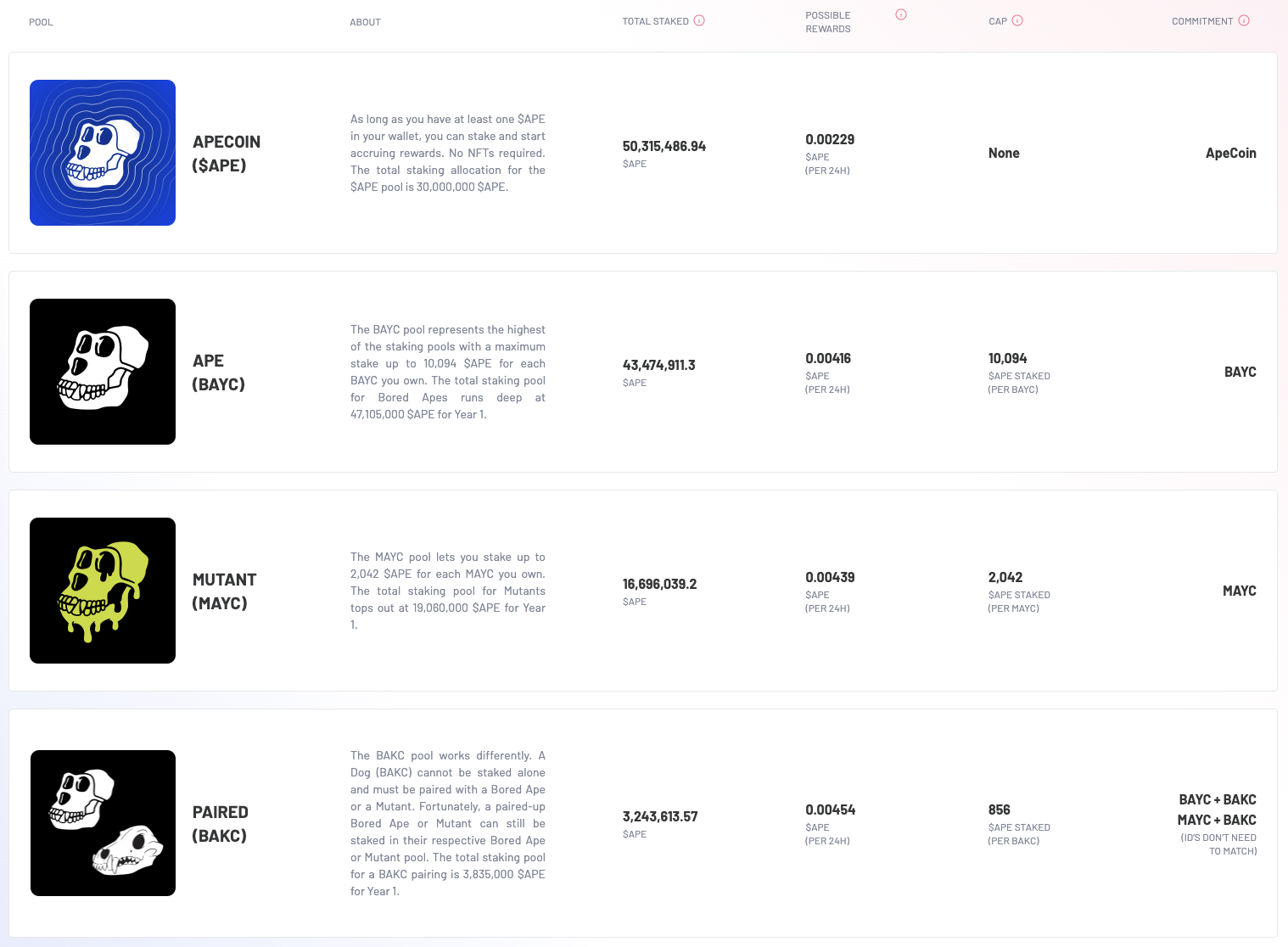
Apestake.io dashboard displays the total number of $APE staked across all available staking pools. Source: Apestake.io; all graphic assets are trademarks of Yuga Labs and its affiliates.
Attracting New Users – some projects may utilize staking to attract new users. High staking rewards are great for marketing and may entice users to purchase a token to receive these rewards. While yield farmers – those who seek to maximize token rewards by optimizing their holdings, may enter and exit a project’s tokens as soon as it benefits them, some users may initially be drawn by high staking rewards and end up as long-term holders. PancakeSwap, a popular decentralized exchange, offers new and existing projects the opportunity to create “syrup pools” – an incentive model that rewards CAKE stakers with new project tokens. These pools are designed to attract new users by providing awareness to new projects through the exchange’s significant audience.
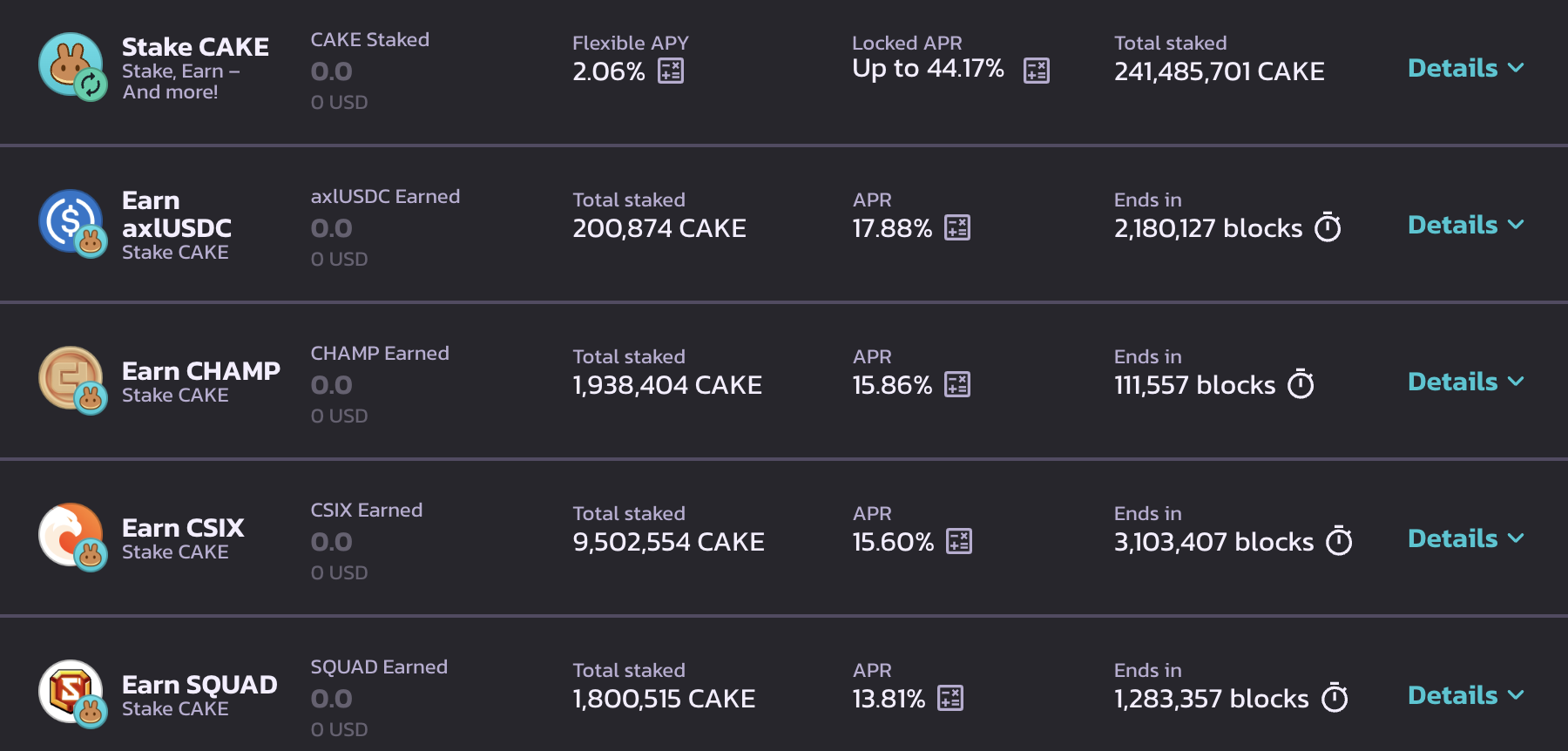
Examples of various project-sponsored, Syrup pools on PancakeSwap.
Distribute Sell Pressure – many tokens purchased in an initial offering may eventually end up as sold tokens in the secondary market, especially if the price has multiplied. Since large price run-ups may occur immediately after launch when liquidity is tightest, staking may help alleviate the resulting sell pressure by incentivizing token holders to stake their tokens for a period of time. This behavior essentially delays the sell pressure to a later time when the project has more stability and liquidity. Since token stakers are unlikely to unstake and sell all at the same time, a project can expect that such sell pressure may also be time-distributed based on each staker’s tolerance.
Community Engagement – oftentimes projects launch as a demo or MVP (minimum viable product) without all of their roadmap features implemented. With limited functionality, the utility of a token may not yet be fully realized, leaving token holders with little to engage with. Staking may serve as a temporary stopgap to utility rollout, providing a purpose for held tokens. Since staking programs can be implemented in limitless and creative ways, a project might leverage staking to keep its community engaged and properly incentivized while it builds against its roadmap.
Ensure Byzantine Fault Tolerance – in proof-based, decentralized, consensus-driven distributed ledgers, the need to prevent byzantine nodes from attacking the network is paramount. In proof-of-stake ecosystems, the economic penalty to attack the network is no longer regulated by the increasingly high energy and hardware costs that protect work-based proofing algorithms. Thus, in PoS ecosystems, the stake itself, while correlated with the amount of rewards, also serves as the mechanism for the penalty as well. Byzantine nodes can be made to forfeit their stake, greatly disincentivizing malfeasance, especially when such stakes are made to be high. In Ethereum, the minimal staking balance to participate as a validator is 32 ETH, ensuring compliance and reducing the potential for attacks.
Types of Staking
While staking is available in many different formats, the two most commons approaches are:
Liquidity Pool Staking – also called liquidity pool mining or LP staking, this form of staking typically occurs on a decentralized exchange such as Uniswap or Balancer. Stakers deposit the liquidity pools paired token at a 50:50 ratio. In return they receive an LP token, allowing them to claim their staked tokens at any time. Stakers earn the swap fees generated by the pooled pair on the DEX based on their pro-rata share of contributed liquidity within the pool. The more swap volume, the greater the LP rewards.

Projects may further incentivize LP stakers by allowing them to stake their LP tokens for additional project token rewards. LP stakers are an important source of secondary market liquidity.
Single-sided Staking – a form of staking in which only a single token is involved. The participant stakes a token and earns additional tokens of the same or different type for doing so. Sometimes staking is linked to an activity such a proofing and validation, and othertimes it is done so passively. All proof-of-stake-based consensus models utilize this type of staking. It is the most popular and simplest form of staking.
Duration and Weight
Staking rewards can be designed to fit a specific staking duration timeframe and weight. For example, a project might specify a minimum holding period in exchange for a fixed rate of reward (expressed in APR or APY) or allow stakers to stake and withdraw as they see fit, but provide a bonus for those that agree to lockup for a certain duration of time. Other platforms may enforce a minimum staking requirement or provide bonuses for certain staked balance thresholds. As an example, the Ethereum protocol sets a minimum staking commitment to enable participation in validator rewards on the network.
Reward Types
One of the most relevant attributes of staking is the type of reward or incentive provided. While the options are potentially limitless, most projects land around the incentive mechanisms we describe below.
Fixed APR – users who stake, earn a yield based on a fixed annual percentage rate or yield (expressed as an APR or APY). The fixed yield can be provided over a term such as a few months, or open-ended until the rewards are exhausted. To maintain a fixed reward, daily token emissions must scale relative to the pool size, therefore some fixed APR pools are capped at the number of participants to ensure the payout can be honored without prematurely exhausting the supply.
Fixed token emission – in this type of reward model, a fixed rate of return is not set. Instead, the project awards a specifically set token amount on a per unit of time or per block basis. Typically, there are no participation caps and the APY is variable, adjusting based on pool participation. Each participant is awarded their pro-rata share of the daily (or other unit of time) staking reward based on the weight of their stake in the entire pool. Thus, a pool with a large number of participants and tokens staked will result in fewer rewarded tokens to each participant, reducing the equivalent APY. As a result, such pools are self-correcting as participants come and go based on the desirability of the market yield.
Effects of Staking Rewards
The relevance of staking rewards as it relates to a token economy is often overlooked. Projects should assume that some portion of tokens rewarded through staking will ultimately be sold on the secondary market. Even if held in users' wallets, the tokens are technically introduced into the circulating supply, resulting in inflation. Thus, tokens emitted in staking rewards must be balanced with tokens unlocking, vesting, or rewarded through other community programs and incentives. Furthermore, in fixed supply ecosystems, staking rewards are finite. Thus, staking programs should be designed to be effective incentive models while accounting for the limited duration of the rewards. Still, the tradeoff of staking-induced inflation may be warranted due to the deferral of sell pressure, and may provide a project with enough runway to stabilize and grow its token value in the earliest days of its launch, where it is most vulnerable.