A common topic in token economics is that of inflation. The effects of inflation are largely overlooked in token ecosystems, yet their effects when mishandled can destroy a token's value, permanently. In the U.S., the topic of inflation has been extremely relevant over the past year, as the Federal government has raised the Federal Funds Rate (commonly referred to as the "interest rate") a total of seven times consecutively, in an effort to tamper the effects of inflation. But where did this inflation come from and how does this example help us to understand its effects on token economies?
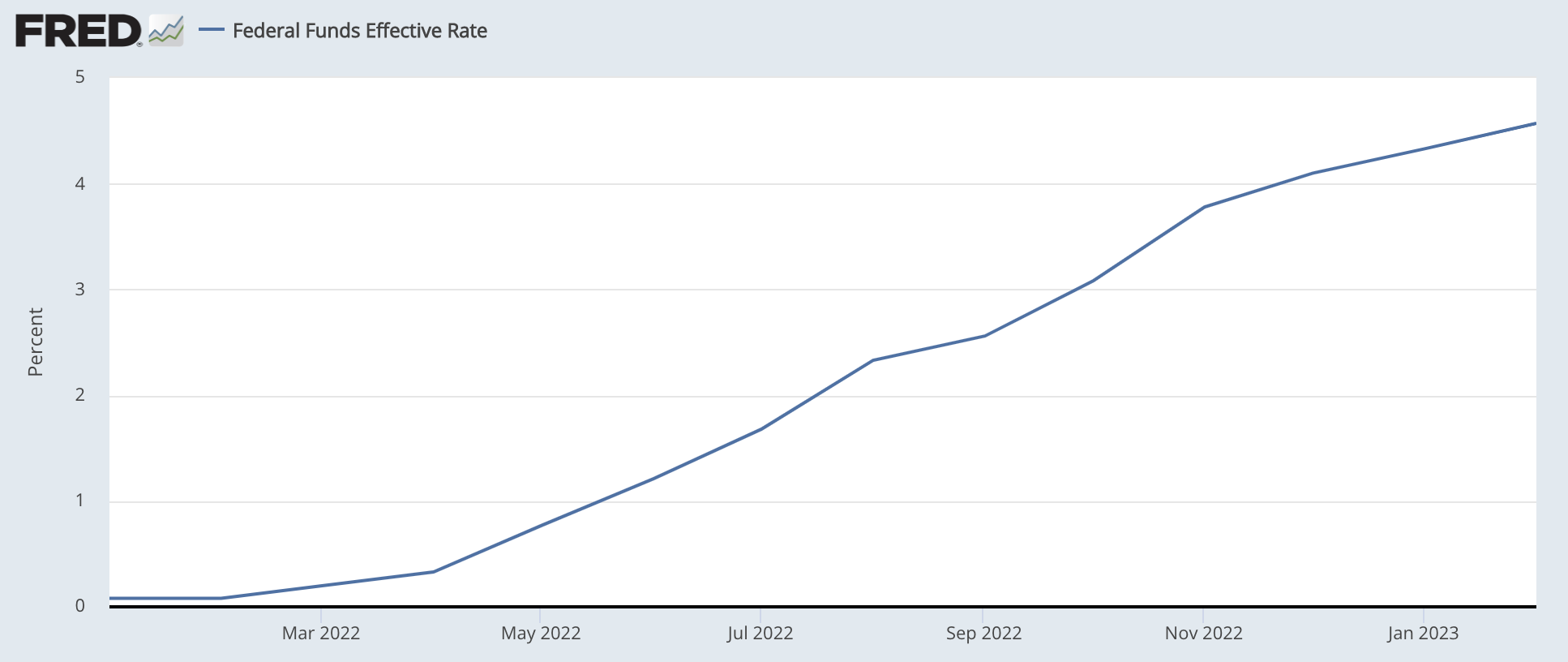
Chart of the U.S. Federal Funds Rate since Feb. ’22 demonstrating trend in rate hikes over the course of the past year. Source: Board of Governors of the Federal Reserve System (US); fred.stlouisfed.org
Case Study: Inflation in the U.S.
Throughout the pandemic, government-mandated lockdowns resulted in substantial declines in revenues for many businesses – an important source of income for many working families. In an effort to counteract this, the government offered financial support in the form of "stimulus payments", effectively minting new dollars and airdropping them to U.S. citizens. In the short term, these payments were a lifeline to the many struggling families. In this way, government fiat is similar to a mintable token – each government can print and create more currency as it sees fit and spend it into the economy.
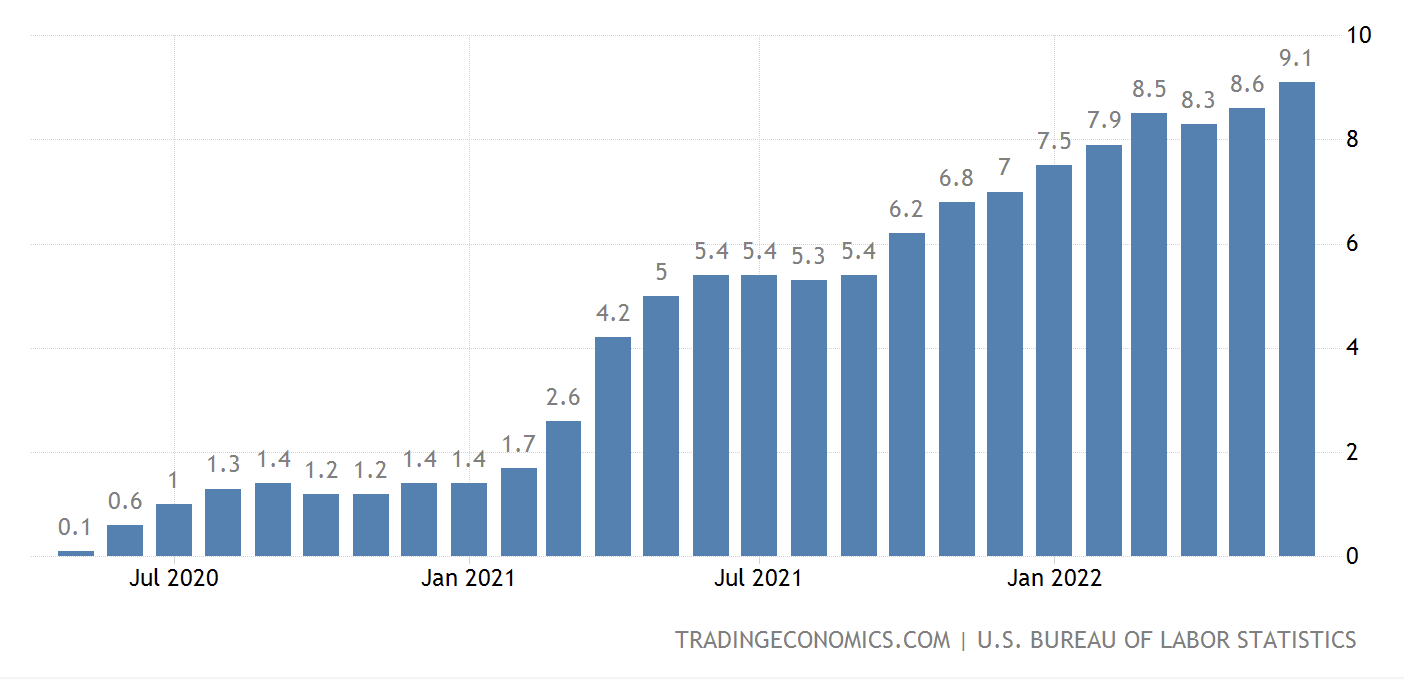
U.S. Inflation rate, measured as Consumer Price Index (CPI); Source: Tradingeconomics.com and U.S. Bureau of Labor Statistics
However, in the broader sense, many of these stimulus payments ended up as disposable income and spending for these families. As the economy slowly opened up, much of these payments entered the circulating supply, resulting in inflation. Inflation is essentially the result of too much money competing for the same goods and services, causing the price of those goods and services to increase. Another way to look at it is that the purchasing power of each dollar is reduced. To correct this, the U.S. government has had to implement aggressive and strict deflationary measures, resulting in the consecutive interest rate increases we are now familiar with.
Causes of Inflation in Token Ecosystems
Simply put, inflation is caused by the introduction of new tokens into the existing circulating supply in market-traded cryptocurrencies. To be more specific, the introduction of these new tokens must be done through the selling of tokens on the secondary market. Moving contract-locked tokens to an unlocked wallet does not necessarily cause inflation, though, technically, such tokens will be reported on token listing sites like CoinMarketCap toward the circulating supply.
Such sources of newly introduced tokens might be from vested tokens claimed by investors and sold on exchanges. Other sources might be reward tokens from staking, gaming, or other community rewards claimed and sold, and project or founder-held tokens that have been vested and sold. The selling of these new tokens makes them more abundant on the secondary market reducing their purchasing power.
Not all token ecosystems experience inflation. Some token supplies are already fully diluted, that is, there are no other tokens locked or held by insiders or the protocol. Other projects may have non-circulating tokens that are not being sold and have no plans on being sold and thus, do not contribute to a project’s short-term inflation.
Other projects experience significant inflation due to aggressive distribution schedules and poor understanding of how project and investor-held tokens might impact market pricing. We see this happen with younger projects that issue tokens through a token sale, or raising capital from crypto VCs and public buyers through an ICO, IDO, IEO, or other public token fundraising event. In such cases, the tokens circulating at listing may be very low, perhaps just 5% of the total supply, and thus the delta between circulating and non-circulating tokens can be very high. Token buyers and issuers alike must be diligent in understanding how the remainder of the tokens are to be introduced into the circulating supply and how the influx of these new tokens might impact their price.
Effects of Inflation on Token Ecosystems
In token ecosystems, the effect of minting new tokens is similar to the effect of governments printing new dollars. Each new unit of value minted dilutes the value of all other circulating currency by the same amount – all things relative. In token ecosystems, this is manifested as a decline in token value proportionally to the value minted over x time. All things equal, minting a certain dollar amount of tokens reduces the value of all circulating tokens by the same amount.
We can see this demonstrated more clearly in the formula below:
Using the above formula and some assumptions, we can illustrate how the minting of new tokens affects token value in the table below:
| Pre-inflation Metrics | New Metrics (after token minting) | ||
|---|---|---|---|
| Circulating Supply (tokens) | 5,000,000 | Newly Minted Supply (tokens) | 1,000,000 |
| Token Value | USD 1.00 | New Circulating Supply (tokens) | 6,000,000 |
| Market Cap | USD 5,000,000 | New Market Cap | USD 5,000,000 |
| New Token Value | USD 0.83 | ||
| Value reduction to token holders | -16.67% | ||
In the above example, we can see how a modest increase in token circulation representing just 20% of the current supply reduces a token’s value by nearly 17%. While this isn’t expected to occur in a single event, the cumulative effects over x time result in the same net effect. With a mintable token, the continuous creation of new tokens essentially guarantees the price of the token will decline, all things equal. Thus, mintable token economies should be evaluated with extra scrutiny.
Fixed token economies too, can experience the effects of inflation, especially as contract-locked tokens vest and are progressively released into the circulating supply. However, since there’s a total supply cap, the number of tokens released into circulation will always be finite. While not always the case, in general, a fixed supply economy will result in more conservative inflation over the long run, as there’s a limit to the total amount of tokens introduced to the circulating supply.
In both cases, the way the tokens are introduced into the circulating supply and resulting secondary market is very important to managing inflation. In general, inflation reduces the purchasing power of tokens resulting in a decline in their prices. Inflation can be masked by a temporary or even sustained surge in buy pressure, but all things equal, will still reduce the value of a token when compared with an ecosystem that is not being diluted by inflation.
Limiting Inflation
Now that we’ve established the effects of inflation, one may ask if it is possible to limit or even prevent inflation from occurring. Technically, the answer is yes – however, the real question is, does eliminating inflation lead to a better outcome? Inflation is a natural phenomenon that is caused by the disbursement and selling of tokens in the secondary market. Since the token supply is typically controlled by the project's founding teams, it should be possible to prevent the future disbursement of tokens or severely limit their introduction into the circulating supply. The Ethereum protocol, for example, has an inflation rate that is just 0.52% annually. A project could also disburse the majority of its supply in a token generation event, or more fairly distribute the tokens to holders instead of concentrating them with early investors, and/or the project and its founding team. However, since a token price is relative to its circulating supply and buying or selling demand, initial price discovery might be a challenging proposition for low-volume tokens with a very large circulating supply. Additionally, while it is not advisable to advocate for engineered volatility, large price swings with positive momentum are at least a strong factor when it comes to the optics of a token to potential investors. Some projects may have a "fighting chance" of building relevancy with traders by slowly introducing new tokens into the supply as demand scales with it, rather than introducing the entirety of the supply upon launch.